
How to Choose the Right Air Duct Cleaning Company in League City
Most air duct cleaning advice tells you to check reviews, verify NADCA membership, and collect three quotes. That advice isn’t wrong, but it filters out the worst actors without helping you tell a competent specialist from a generalist with a shop vac and a logo. The real questions are simpler and more concrete: what equipment will be in the driveway, and what exactly does the quote cover? Get specific answers to those two things and you’ll avoid the bad jobs before anyone rings your doorbell.
Why Standard Vetting Advice Falls Short
A NADCA membership costs a few hundred dollars a year and requires no equipment inspection. It’s a legitimate credential worth checking, but it tells you nothing about whether the truck pulling up carries a Rotobrush or a leaf blower duct-taped to a bag vacuum. We’ve seen the aftermath of that setup, and it usually looks worse than doing nothing.
Reviews help, but they’re easy to game and hard to read. A five-star review from someone who paid for a “blowout special” and got a light dusting doesn’t tell you whether the work was done correctly. Neither does a certificate on a website.
The differentiator that actually predicts quality is equipment disclosure and scope specificity. A company that can name its agitation method, its vacuum system, and its containment approach before you book is a company that thinks about the technical work. A company that can only tell you it’s “licensed and insured” is telling you what it spent money on, not how it cleans ducts.
Here’s the good news: you don’t need to become an expert. You need to ask five questions and listen for whether the answers are specific or vague.
The Five Questions to Ask Before Booking
A legitimate duct cleaning company can answer all five of these without checking with a supervisor. If you get a pause on any of them, keep shopping.
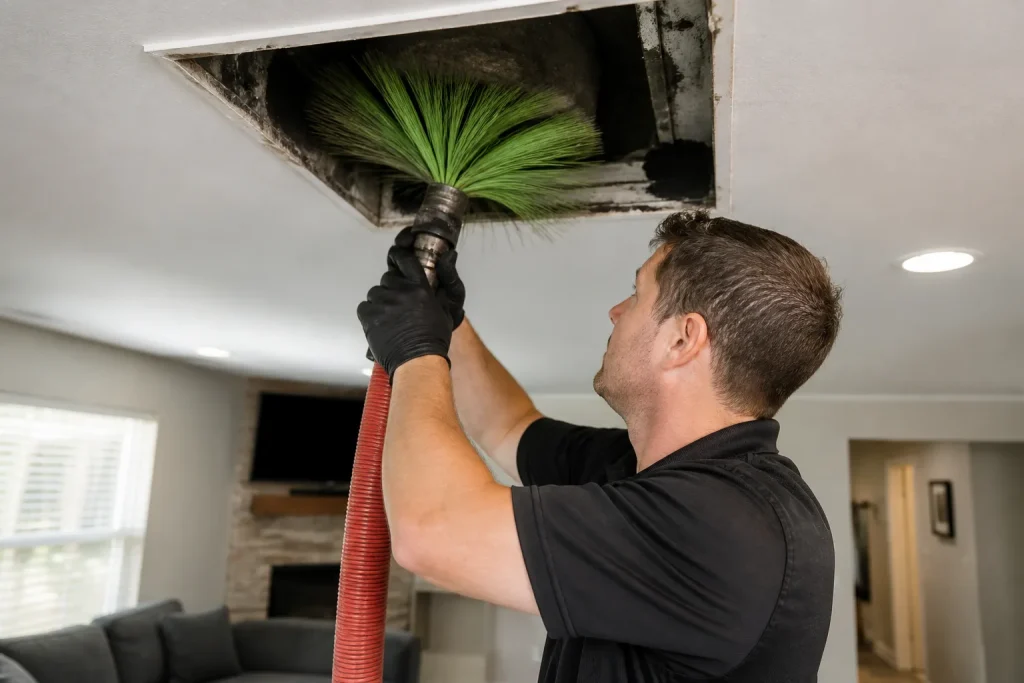
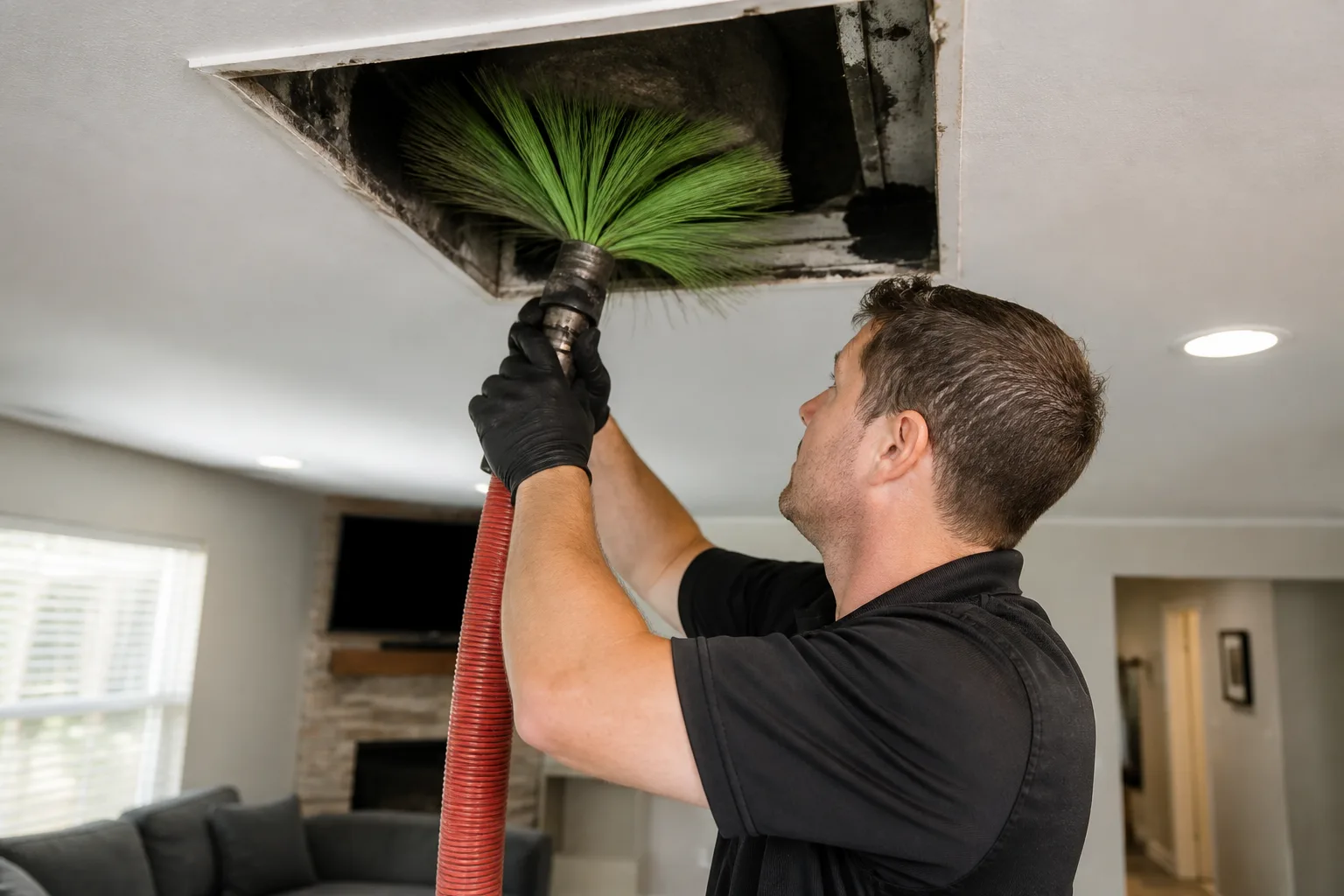
- What exact equipment will you bring? “We use a truck-mounted unit” is not an answer. “Rotobrush brush-and-vacuum system plus a Nikro HEPA-rated vacuum” is. Brand names matter here because they’re verifiable, and they signal contractor-grade gear rather than repurposed consumer equipment.
- How do you agitate the debris? Suction alone doesn’t dislodge what’s bonded to duct walls. Mechanical brushing does. If the answer is “high-pressure air,” ask where the loosened debris goes. The answer should involve negative pressure and a collection system, not your living room.
- How do you establish negative pressure? A real setup uses a vacuum sealed to the system and HEPA filtration to capture particulates at the source. Without negative pressure, cleaning just recirculates dust. Ask how they seal the connections.
- What gets documented after the job? Before-and-after photos of the interior duct surfaces, not just a receipt. Ask to see examples of that documentation from a recent job.
- What happens if you find a problem? Torn flex duct, disconnected sections, or damaged registers found mid-job need a plan. A company that can repair what it finds is more useful than one that can only clean.
Write those five answers down. The company that gives you specific replies is the one to book. If you’d rather not run the interview yourself, call (866) 942-5170 and we’ll walk you through what our technicians bring and what we document.
Why Specialization Matters in Duct Cleaning
An HVAC generalist treats duct cleaning as a small service line bolted onto install and repair work. That’s not a knock on their trade skills; it’s a statement about where their equipment budget goes. A company doing duct work every day invests in Rotobrush and Nikro systems because they’re the core of the business. A company that cleans ducts twice a week invests in a shop vac and calls it done.
The technical gap shows up in three places:
- Containment. Abatement Technologies equipment is designed for mold, heavy allergen loads, and post-renovation debris. It’s what restoration professionals use. If your ducts have been through a renovation or a moisture problem, this matters more than a low price.
- Filtration compatibility. Homes with Honeywell or Aprilaire filtration need a technician who understands the equipment and works around it without bypassing or damaging it. A generalist might not know these systems well enough to leave them intact.
- Repair capability. Cleaning without repair means problems stay problems. Specialists who offer both can fix what the cleaning reveals. We clean ducts. We also fix them.
In League City, where construction has added hundreds of homes in the last decade, duct systems are often newer but not always installed cleanly. Flex duct runs that were crimped during installation restrict airflow for years before anyone notices. A specialist catches those during cleaning. A generalist finishes the job and moves on.
What Your Quote Structure Tells You
Quotes in this trade come in two shapes: flat-rate whole-home pricing and per-vent pricing. They tell you different things about the person writing them.
Per-vent pricing sounds consumer-friendly (“$20 a vent!”) but it creates a structural incentive to do less. Fewer vents means a lower bill, so the pressure is to move fast and finish early. It also means scope creeps up at the door (“that’s actually two runs, so that’s an extra charge”). Chevron the per-vent number against what actually gets cleaned, and the bargain evaporates.
Flat-rate whole-home pricing is agreed before the technician arrives. It covers the whole system: main trunks, branch runs, registers, and the air handler connections. No surprises, no per-vent math. That structure rewards thoroughness because the price is set regardless of how long the job takes.
When you get quotes for air duct cleaning in League City, ask what happens if they find a disconnected run or a damaged trunk. A flat-rate quote plus a clear policy on repairs is what professionalism looks like. A quote with three asterisks and a “starting at” price is what it looks like when it goes wrong.
League City-Specific Vetting
Local conditions shape what a duct cleaning job actually involves. Ask about these things specifically:
- Slab-on-grade construction. Most homes here sit on a slab, which means ductwork runs through the attic or crawl space rather than a basement. Ask how the technician accesses the system and whether attic runs are included in the scope. Some companies skip the harder-to-reach sections.
- Flex duct systems. Flex duct is common in newer construction and can sag, kink, or disconnect. Ask whether the company checks for disconnected sections and can repair them, or just cleans what’s reachable.
- Post-storm contamination. After a significant storm or roof repair, fine debris and moisture can get into the duct system. Ask whether the company has equipment rated for that kind of situation, and whether containment is standard on those jobs. Abatement-rated gear is the right answer.
- Dryer vent safety. dryer vent cleaning should be part of the conversation for any homeowner in League City, especially in homes more than a few years old. Lint accumulation in the exhaust path is the leading cause of dryer fires, and it’s a fire-safety service, not an optional add-on.
The company that answers these questions with confidence is the one that works in League City regularly. The one that seems surprised by the questions isn’t.
What a Legitimate Post-Job Deliverable Looks Like
You should walk away from a duct cleaning with more than a receipt. The minimum deliverable is before-and-after photos of the interior duct surfaces. Not a photo of the register before and after. Not a picture of the vacuum running. Photos of what the inside of the ducts looked like before and after cleaning. If the company can’t provide that, the work wasn’t documented, which means it probably wasn’t verified.
Good documentation also includes:
- A short note on what was found (heavy debris in the return, a disconnected branch, a damaged section of flex duct).
- An itemized record of what was cleaned, including which runs got attention.
- If repairs were needed, a clear description of what was done.
- Any concerns about filtration equipment, especially if the home has Honeywell or Aprilaire components.
If your current provider handed you a receipt and nothing else, that’s your sign to look elsewhere. The absence of documentation is the single most reliable red flag in this trade.
When to Call a Pro
If you’re asking whether your ducts need cleaning, they probably do. Common signs include visible dust on the registers, musty odors when the system runs, a recent renovation, pest activity, or a system that just doesn’t push air the way it used to. Those signs are worth a call. A cheap cleaning that makes no visible difference usually means one of two things: the system didn’t need it, or the equipment wasn’t strong enough to do the job.
If the ducts themselves are damaged, cleaning alone won’t help. We repair damaged and disconnected duct sections, which means what the cleaning finds can be fixed in the same visit. That’s the difference between a cleaning company and a duct specialist. For more on what we do, see Duct Cleaning League City.
Related services in League City: air duct cleaning, dryer vent cleaning, and air duct repair.
Key Takeaways
- NADCA membership and star ratings filter out the bottom of the market but don’t tell you what equipment will show up.
- Ask five specific questions: equipment brand, agitation method, negative pressure setup, documentation process, and repair capability.
- Flat-rate whole-home pricing signals scope discipline. Per-vent pricing signals a race to the door.
- In League City, ask about slab-on-grade access, flex duct repair, and post-storm contamination experience.
- Before-and-after photos of interior duct surfaces are the minimum acceptable deliverable.
- Specialists who clean and repair are more useful than cleaning-only companies, because problems found mid-job get fixed.
The Bottom Line
Choosing the right duct cleaning company comes down to two things: equipment you can name and scope you can verify. The company that tells you exactly what it brings, how it cleans, and what it documents is the one that will do the work correctly. Everything else is noise.
If you’re in League City and want a straight answer about what your ducts need, Duct Cleaning League City offers free estimates. Our technicians have up to experience and work with Rotobrush, Nikro, and Abatement Technologies equipment on every job. We answer 24/7. Fast dispatch from 7am to 7pm, Sunday through Friday. Call (866) 942-5170 for a free estimate.
Frequently Asked Questions
Most whole-home duct cleanings in League City fall in a range based on system size and accessibility, and the final price is set per job by the written estimate. We don’t quote per-vent prices because that structure encourages cutting corners. Call (866) 942-5170 for an exact quote. Estimates are free.
Cheap quotes usually reflect cheap equipment, limited scope, or a per-vent structure that creeps up at the door. A low headline price often means a shop vac instead of a Rotobrush brush-and-vacuum system, or a partial cleaning that skips the harder runs. Ask what equipment comes to the job and what the quote actually covers. Call (866) 942-5170 for a quote you can compare line by line.
You’ll know because you’ll see before-and-after photos of the interior duct surfaces. That documentation is standard on a legitimate job and missing on a bad one. If a company can’t produce it, ask why. Call (866) 942-5170 to see examples of what we document.
Most homes benefit from duct cleaning every few years, but the interval depends on the home. Recent renovations, pets, moisture issues, and heavy dust loads shorten the cycle. Homes with well-maintained Honeywell or Aprilaire filtration can stretch the interval. In League City, post-storm checks are worth doing if you’ve had roof repair or water intrusion. Call (866) 942-5170 and we’ll help you figure out what your system needs.
Written by the team at Duct Cleaning League City.
Need Air Duct Cleaning Help?
Call Duct Cleaning League City - licensed & insured, here with fast help in League City.
(866) 942-5170