
Emergency Air Duct Cleaning Near Me: What League City Homeowners Should Do First
If smoke, flood water, or visible mold has just hit your home, the first move isn’t to call a duct cleaner. It’s to shut the HVAC system down at the thermostat. Running the system, even for a minute to “see if it still works,” pushes soot, spores, and debris through every branch of the ductwork before a technician ever arrives. We’ve walked into plenty of League City homes where that one reflex turned a contained mess into a full remediation. Here’s the order that actually works.
If you’d rather not sort through it alone, call (866) 942-5170. We answer 24/7. Fast dispatch from 7am to 7pm, Sunday through Friday.
Key Takeaways
- Shut off the HVAC at the thermostat before anything else.
- Clean-water flooding and construction dust usually call for restoration cleaning; mold, sewage, and fire smoke call for remediation-level work with containment.
- Document everything with photos and moisture readings before cleaning begins.
- Ask any company quoting “emergency” service whether they carry containment equipment.
- Some situations need an industrial hygienist’s testing before any mechanical cleaning touches the ducts.
Why Step One Is Always Shutting Down the HVAC
Stopping the air handler is the single most protective action a homeowner can take in an indoor air emergency. The system is a distribution network: whatever gets pulled into the return gets pushed out at every supply register in the house. Soot from a kitchen fire, mold spores from a wet ceiling, or fine drywall dust from a renovation all travel the same path. A running blower turns one contaminated room into a contaminated house.
Here’s what we tell League City homeowners to do in the first few minutes:
- Set the thermostat to OFF. Don’t switch it to fan mode either, since that spins the blower just the same.
- If the thermostat controls a heat pump and you’re unsure how to fully disable it, trip the breaker labeled for the indoor unit. Note which breaker you switched.
- Close interior doors to rooms nearest the source to slow cross-airflow.
- Don’t run ceiling fans, portable fans, or a shop vac near the affected area. Those move particles as effectively as the HVAC did.
- Write down the time you shut the system off. That timestamp becomes the start of your documentation trail.
The instinct to “air the house out” with the system running is understandable and almost always backwards. Ventilation helps after the source is contained, not before. We’re not saying leave the house dark and still forever, just that the blower stays off until someone qualified has looked at the ductwork.
Remediation or Restoration? Reading the Situation in League City
Not every dirty-duct emergency is the same category of job, and the difference decides who you call. Restoration cleaning handles contamination that’s dirty but not biologically risky. Remediation cleaning handles contamination that can affect health or structure. In our experience, homeowners under stress don’t always know which one they’re facing.
Signs you’re looking at restoration cleaning
- Flooding from a clean source: a supply line, a water heater, rainwater coming in through a window
- Construction or renovation dust from drywall, sanding, or demolition
- General accumulated debris after a long stretch without service
- Light smoke odor from cooking, with no visible soot in the registers
Signs you need remediation-level work
- Visible mold growth inside registers, on grilles, or around the air handler
- Sewage backup or Category 3 water, which carries pathogens regardless of how it looks
- Fire or wildfire smoke with soot residue, especially after a structure fire
- Persistent musty odor that returns after airing the house out
That second list is where equipment matters. Cleaning ducts affected by mold or heavy fire debris calls for HEPA-rated collection and containment, not a shop vac and a hose. Our air duct cleaning work uses Abatement Technologies containment equipment and Nikro HEPA-rated vacuums for exactly these situations, because lofting spores into the living space during cleaning defeats the point. League City’s humid stretches make moisture-related mold more likely, so we treat it seriously rather than as a sales line.
What to Document Before Cleaning Begins (Insurance Matters Here)
If you plan to file a claim after a League City storm, flood, or fire, the evidence you capture before anyone cleans is what carries the file. Insurance adjusters work from documentation, not memory. Once a crew runs a brush through a duct, the pre-existing condition is gone.
Before scheduling, capture this:
- Photos of everything – each affected register, the air handler, the return grille, and any visible mold or soot. Shoot wide and close. Date stamps help.
- A moisture baseline – a cheap pin meter reading at the duct insulation and nearby drywall gives the adjuster a number to work from.
- A written timeline – when the event happened, when you shut the HVAC off, when you noticed odor or visible growth.
- Any air quality reading – if you already own a particulate monitor, save its readings or screenshots from before and during the event.
- The name and contact of whoever inspected first, whether that’s a restoration company, an insurance adjuster, or our team.
We routinely tell customers to keep a folder on their phone for this. It’s boring, and boring is what gets a claim approved. If your insurer wants to see the duct condition documented as part of the estimate, we can photograph the inside of the system before we start cleaning and again after. That’s one of the reasons we work with your insurer rather than around them.
Emergency Response vs. Standard Scheduling: Ask This Question
Plenty of companies advertise “emergency air duct cleaning,” but emergency in this trade means something specific: same-day access, a technician who arrives with containment gear, and the ability to stop cross-contamination while working. If a company’s “emergency” service is a standard brush-and-vacuum done faster, they’re not set up for what you’re actually facing.
Ask three questions before you book anyone:
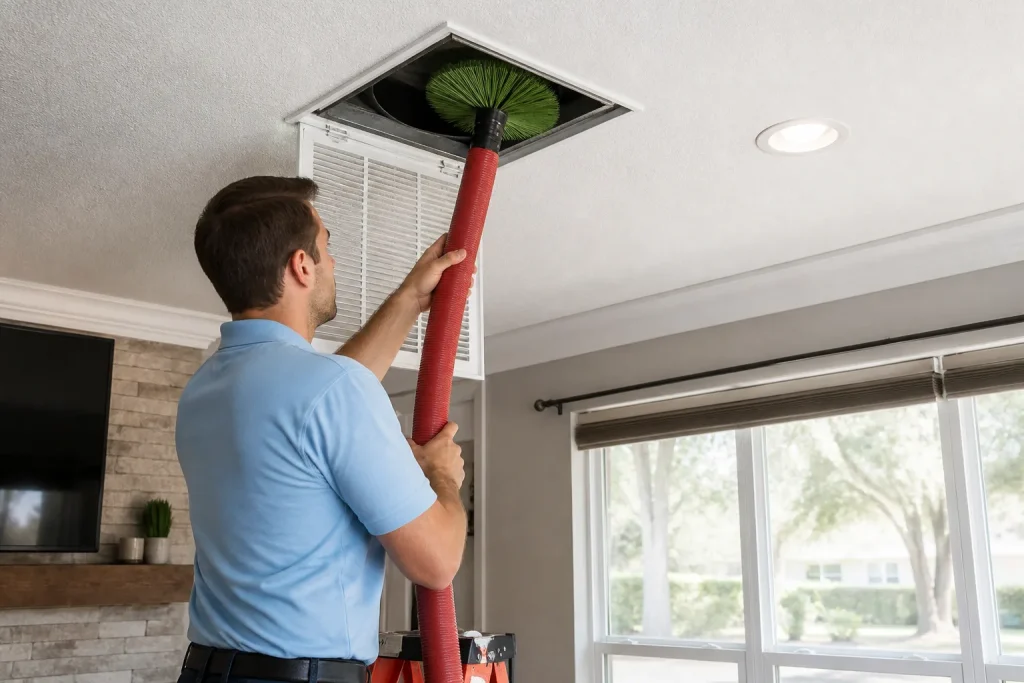
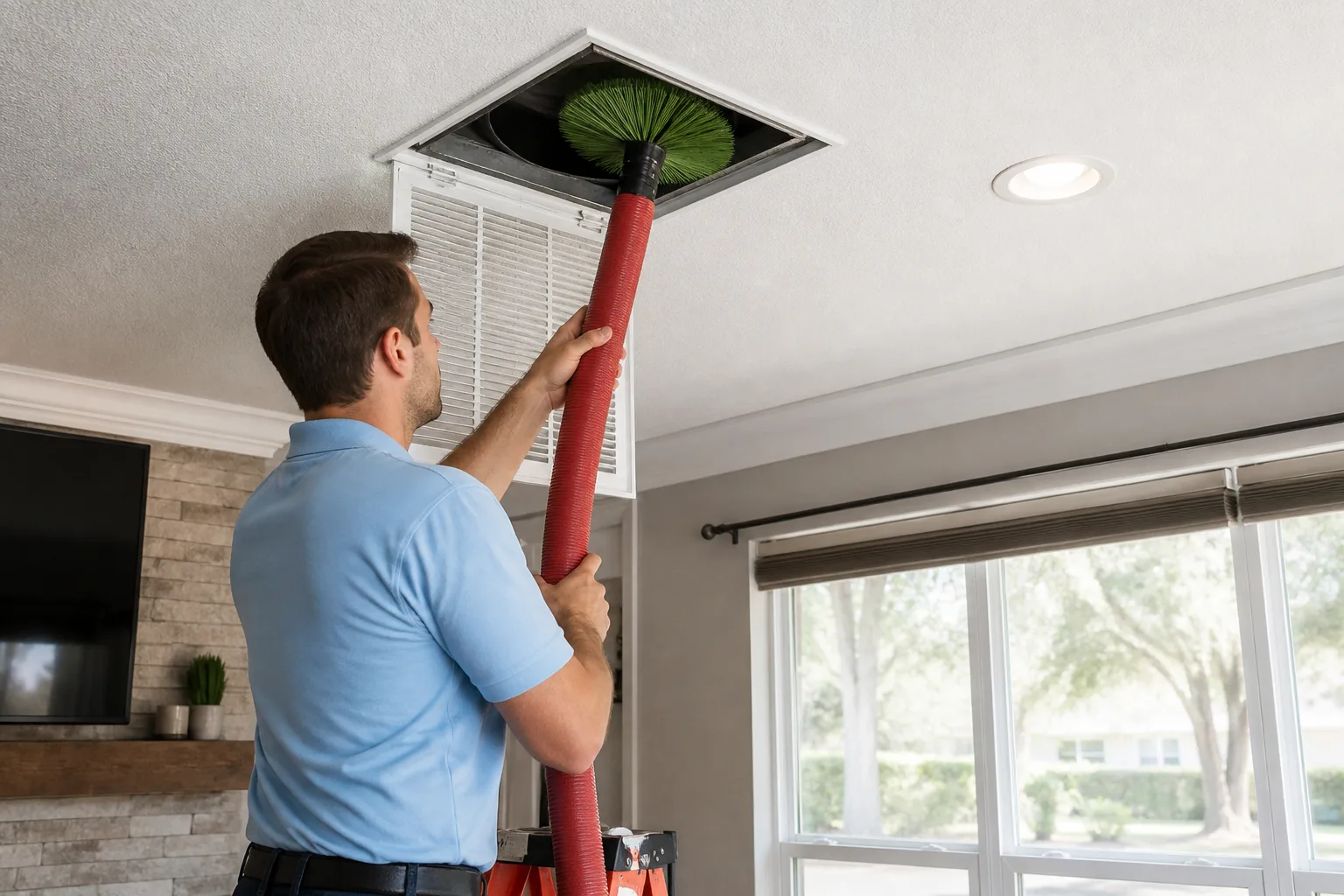
- “Do you bring containment equipment, or just a vacuum?” For mold or smoke work, you want the answer to include containment barriers and HEPA filtration. Rotobrush mechanical systems agitate debris loose; Nikro HEPA units capture the fine particulates at the source. Together they cover the job; a single unit rarely does.
- “Can you repair duct sections if you find damage?” Floods and fire events can disconnect or crush flex duct. A cleaner who can only clean will hand you a punch list you’ll have to schedule separately. We handle duct repair as part of the same visit, which matters when the system is already down.
- “Do you work around Honeywell or Aprilaire equipment?” If your home has a high-performance filtration system or an in-line media cabinet, the cleaning shouldn’t bypass or damage it. We work with both systems and know how to service the ducts without disturbing components that are doing their job.
When the system is off and the situation is urgent, you want one visit that cleans, repairs if needed, and verifies the result, not a relay race between three contractors.
When to Involve an Industrial Hygienist
An industrial hygienist tests and interprets; a duct cleaner cleans. Most emergencies don’t need testing first, but some do, and knowing the threshold protects you from paying for cleaning that can’t solve the real problem.
Bring in an industrial hygienist before any mechanical cleaning if:
- Anyone in the household has a compromised immune system, asthma, or a known mold sensitivity
- You suspect mold behind drywall or above ceilings, or a musty odor persists after a prior cleaning
- Sewage has backed up into the system or soaked insulation around it
- You’re pursuing an insurance claim that hinges on establishing contamination levels
- A previous “emergency” cleaning made the odor or symptoms worse, not better
A hygienist’s report gives you a baseline and a scope. Once you have it, a cleaning crew knows exactly what they’re dealing with and what verification the job needs at the end. That’s the right sequence. Cleaning first and testing later is how people end up paying twice. In League City, where a single storm can soak a house and warm weather can grow mold quickly afterward, we recommend the testing step whenever the conditions above apply.
When to Call a Pro
If any of these are true, it’s time to stop investigating and get a technician scheduled:
- The system is off and you’re unsure whether it’s safe to restart
- You can see mold or soot inside the registers
- There’s standing water or damp insulation anywhere in the duct path
- A musty or smoke odor returns within a day of airing the house
Call (866) 942-5170. We answer 24/7. A call outside dispatch hours is booked into the next opening, Sunday through Friday, 7am to 7pm. If you already know you need duct cleaning, the free estimate is the place to start; if you suspect a dryer vent is part of the problem, that’s a separate fire-safety job we handle as its own service.
Related services in League City: dryer vent cleaning and League City service info.
The Bottom Line
The sequence is what saves the house: shut the HVAC off, figure out whether you’re facing restoration or remediation work, document everything before anyone touches the ducts, and make sure whoever you call has the equipment for the job you actually have. Cleaning is not step one. It’s step three or four, done by a crew with real containment gear. Our technicians have up to experience, and we bring the same Rotobrush and Nikro systems restoration contractors use, not consumer-grade vacuums.
If you’re in League City and need help, Duct Cleaning League City offers free estimates. Call (866) 942-5170. We answer 24/7. Fast dispatch from 7am to 7pm, Sunday through Friday. You can also start at Duct Cleaning League City.
Frequently Asked Questions
No. Running the system moves soot, spores, and dust through every duct branch in the house. Shut the thermostat to OFF first, and don’t switch to fan mode either, since that still runs the blower. If you’re not sure how to disable the indoor unit, call (866) 942-5170 for a free estimate. We answer 24/7.
No. Emergency work usually means same-day access plus containment equipment, so contaminated air isn’t distributed while cleaning happens. A company that only offers a faster standard cleaning without HEPA vacuuming and containment can’t do remediation-level work. Ask before you book; if you’re still unsure, call (866) 942-5170.
The price depends on the scope: number of systems, size of the ductwork, and whether the work is restoration-level or remediation-level with containment. We set the price per system with a written estimate before any work starts, so there are no surprises. Call (866) 942-5170 for an exact quote; estimates are free.
Sometimes, yes. If you suspect hidden mold, have a health-sensitive household member, or are filing an insurance claim that turns on contamination levels, a hygienist’s testing should come first. For clean-water flooding or construction dust, testing usually isn’t necessary and cleaning can start. Call (866) 942-5170 to talk through which situation applies to you.
Written by the team at Duct Cleaning League City.
Need Air Duct Cleaning Help?
Call Duct Cleaning League City - licensed & insured, here with fast help in League City.
(866) 942-5170