
Nikro Air Duct Cleaning in League City: A Homeowner’s Guide
Ask a homeowner what brand of vacuum their duct cleaner uses and you’ll usually get a shrug. That’s the problem. Without any frame of reference, most people default to price, and price alone tells you nothing about what happens inside your ducts. Nikro portable extraction units belong to a different class of machine than what most cut-rate crews bring. Understanding what they do mechanically is the fastest way to tell a real cleaning from a sales pitch. If you’d rather not sort that out yourself, call (866) 942-5170.
What makes a Nikro air duct machine different from a shop vac?
A shop vac pushes as much air back out as it pulls in. A Nikro negative-air unit is built to do the opposite: create a sustained pressure differential across the whole duct system so debris moves toward the collection point instead of swirling around your living room. That difference is mechanical, not marketing. Restoration contractors use the same class of equipment to contain and pull out particulates during mold remediation, and there’s a reason they don’t improvise with consumer gear.
Here’s what’s actually happening:
- Negative pressure: the machine pulls the duct system into a slight vacuum relative to the room. Air (and the dust riding in it) moves toward the extraction point, not out through supply registers.
- Sealed collection: debris lands in a containment bag or drum, not on your furniture. A proper setup includes register covers and work-zone protection.
- HEPA-rated filtration: fine particles that pass the pre-filter get caught rather than exhausted back into the room. That’s the whole point for anyone with allergies or a home with mold history.
In our experience around League City, the homes that get the least value from a cheap cleaning are the ones with the most dust sitting in the system. A machine that can’t hold negative pressure can’t move it out.
What does 99.97% at 0.3 microns actually mean at home?
That figure describes HEPA capture efficiency at the hardest particle size to trap: 0.3 microns, which happens to be right around the size of many mold spores and fine allergen particles. Standard bag filters in a shop vac let a meaningful share of that fraction pass straight through and back into the air. The practical result is a cleaning that looks productive and leaves the finest, most irritating particles circulating.
For a League City home with pets, seasonal allergens, or a recent renovation, that fine fraction is the part that matters. Coarse debris gets stopped by almost anything. Mold spores and drywall dust sit in the range a HEPA filter is engineered to catch.
What this means for you:
- If your ducts have visible mold growth or heavy allergen load, HEPA-rated extraction isn’t optional.
- If a contractor can’t tell you what kind of filtration their machine uses, that’s your answer.
- If someone quotes a cleaning with a standard shop vac and a long hose, the fine particles are going back into your air.
The air duct cleaning we perform pairs Nikro HEPA extraction with Abatement Technologies containment gear when conditions call for it, because a contaminated system needs more than suction.
Why does a Nikro unit need agitation to work?
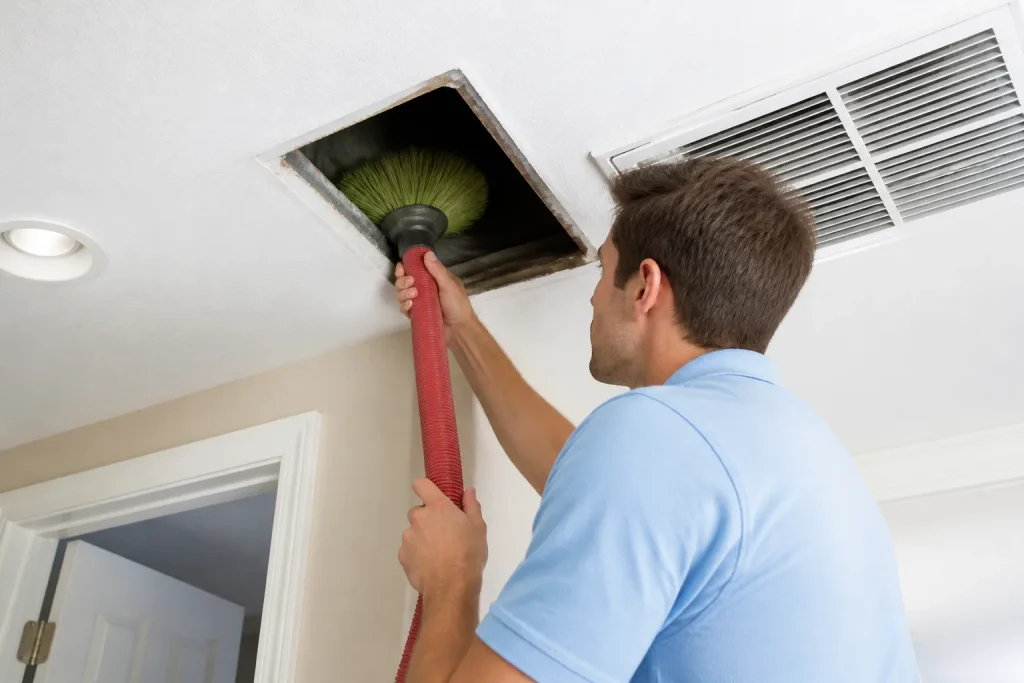
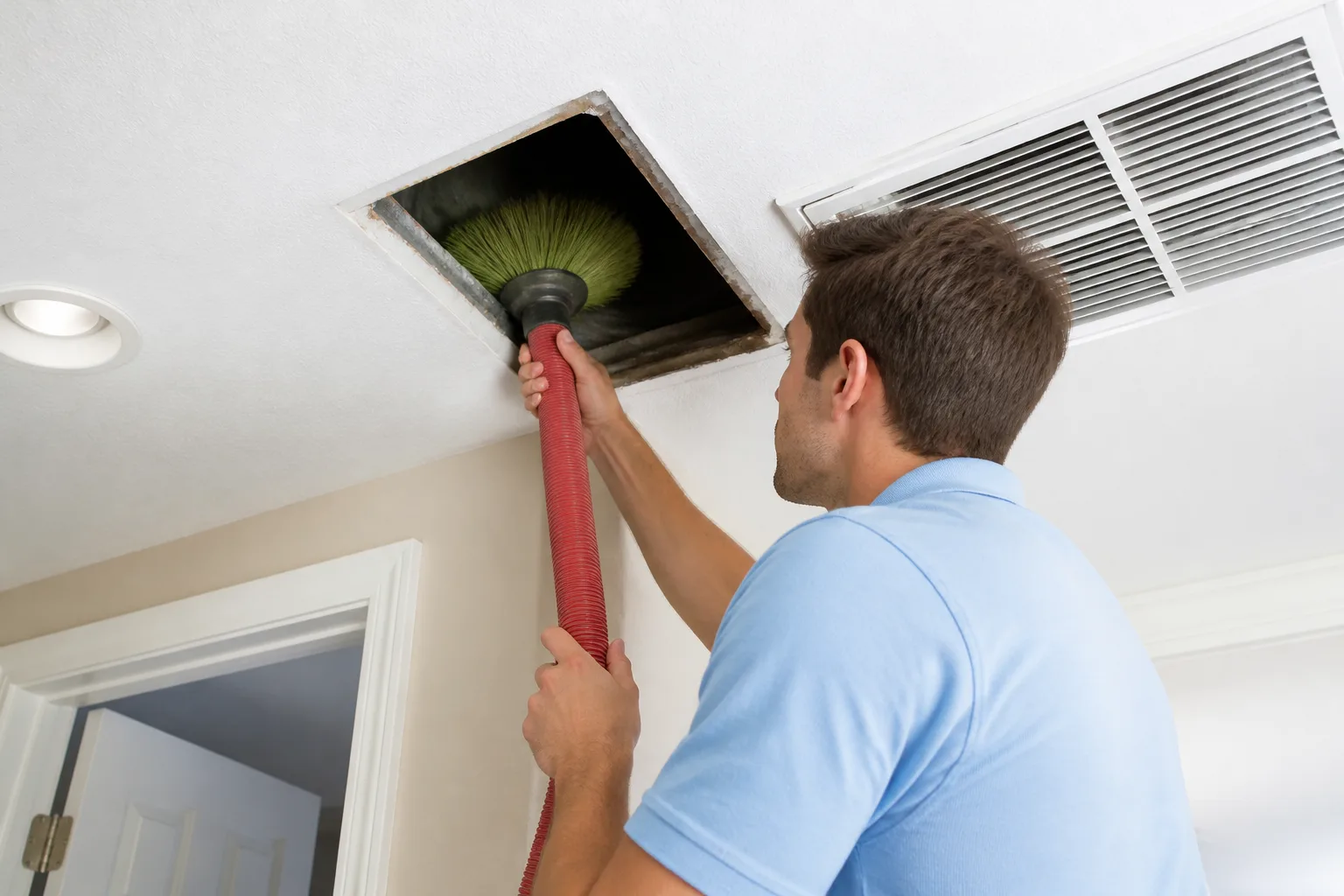
Suction alone can’t dislodge dust that has bonded to duct walls, settled into seams, or packed into the joints where sections meet. A negative-air machine pulls loose debris fine, but the caked-on layer needs mechanical breakup first or it just sits there while the vacuum runs. That’s why Nikro units are paired with a Rotobrush brush-and-vacuum system or compressed-air whips rather than used standalone: agitation loosens, extraction removes.
When a crew runs extraction without agitation, you get the classic “duct cleaning that made no difference” outcome. The machine works. The debris never got freed to be captured.
A typical agitation-and-extraction sequence for a League City home looks like this:
- Seal registers and set up negative-air containment at the main trunk.
- Insert the agitation tool (Rotobrush brush head or air whip) section by section.
- Run agitation forward and back to break contact between debris and duct lining.
- Extract the loosened material while negative pressure holds.
- Inspect and document before-and-after condition.
That last step is where honest work separates from the rest. You should see the photos of your own ducts, not a stock image.
Portable negative-air vs. truck-mount: which actually cleans better?
Truck-mount systems have their place, but they were designed around accessibility and hose reach, not multi-level homes with tight mechanical closets. A portable Nikro unit brings the vacuum to the duct system instead of running a long hose from a truck and losing suction along the way. For a two-story League City house with an air handler tucked into a narrow closet, that difference is real.
Comparison points to know:
- Portable: full suction at the register, works on multi-story homes, no long hose runs, easy access to tight mechanical rooms.
- Truck-mount: can lose meaningful pressure at distance, awkward in irregular layouts, but convenient when the system is simple and the truck parks close.
- Equipment pairing: portable units integrate cleanly with agitation tools and containment gear, which is how a full cleaning is actually done.
We’re not claiming one machine wins every scenario. What we do know is that a portable Nikro in trained hands with the right agitation tools outperforms a truck-mount hose run from a sketchy parking spot. Same principle for dryer vent cleaning: the machine matters, and so does bringing the right tool to the vent.
How can you verify the equipment is actually being used?
This is the question almost nobody asks, and it’s the one that protects you. You don’t need to know how a Nikro unit is plumbed. You need to recognize the signs of real work versus theater.
What to look for during a cleaning:
- See: a portable extraction unit on site, sealed register covers, drop cloths or work-zone protection, a vacuum drum or containment bag being filled.
- Hear: sustained machine noise through the entire job, not just the first ten minutes. Agitation tools operating section by section.
- Verify: before-and-after photos of your own duct interiors, not marketing images. A technician willing to walk you through what they found.
If the “machine” is a shop vac and the technician leaves before the job finishes, the equipment story is settled. Our technicians have up to experience and can tell you exactly which tools they’re using on your system, including how they work around high-performance filtration components like Honeywell or Aprilaire systems without bypassing them.
When to call a pro
If you’ve had a low-cost cleaning that made no visible difference, if you can see mold growth at a register, or if a connected duct section is loose or disconnected, that’s the point to stop guessing and get it assessed. Duct repair is part of what we do, and sections we find compromised during cleaning get addressed in the same visit rather than deferred. That’s the gap most competitors leave open.
Related services in League City:
If you’re local and want the full picture, our main page at Duct Cleaning League City covers what we do and what we don’t.
The Bottom Line
Nikro air duct cleaning in League City sits in a different equipment class than the bargain services that bounce from neighborhood to neighborhood. Negative-air extraction creates the pressure differential that moves debris out, HEPA filtration captures the fine fraction standard filters miss, and pairing the machine with Rotobrush agitation is what actually frees the bonded dust. The equipment story is not a sales gimmick. It’s the answer to why one cleaning leaves your ducts looking and smelling different than the next.
If you’re in League City and need help, Duct Cleaning League City offers free estimates. Call (866) 942-5170. We answer 24/7. Fast dispatch from 7am to 7pm, Sunday through Friday.
Frequently Asked Questions
Pricing depends on the size of the duct system, the number of registers, and the level of contamination, so we set one flat price per system from a written estimate rather than per-vent pricing. You get the number before work starts, and that number is what you pay. Call (866) 942-5170 for an exact quote, estimates are free.
Usually because the equipment isn’t the same class. A shop vac and a single hose can be offered at a low price because that’s what it is. A Nikro negative-air unit with HEPA filtration, paired with agitation tools and containment gear, costs more to run correctly, and that shows up in the honest range. Call (866) 942-5170 if you want a straight explanation of what a proper job for your League City home involves.
You see the machine on site, hear it running through the whole job, and receive before-and-after photos of your own duct interiors. Every cleaning includes that documentation. Call (866) 942-5170 to schedule and we’ll walk you through the process before we start.
It depends on the home: pets, recent renovation, smoking, allergy concerns, and visible mold all shift the timeline. Many League City homes do fine every few years; homes with heavy shedding pets or a recent remodel often need it sooner. If you’re unsure, a professional inspection answers the question better than a calendar. Call (866) 942-5170 for a free estimate.
Written by the team at Duct Cleaning League City.
Need Air Duct Cleaning Help?
Call Duct Cleaning League City - licensed & insured, here with fast help in League City.
(866) 942-5170